16 neurons
16 neurons on a live round screen. Tap to rewire them, or turn the seeds for a new network.

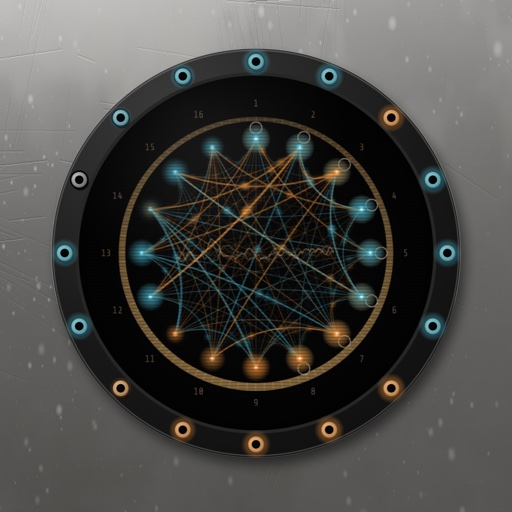
A small cybernetic instrument: sixteen neurons in feedback, listening and answering each other. Steer it, nudge it, strike it, and hear it find its own rhythms.
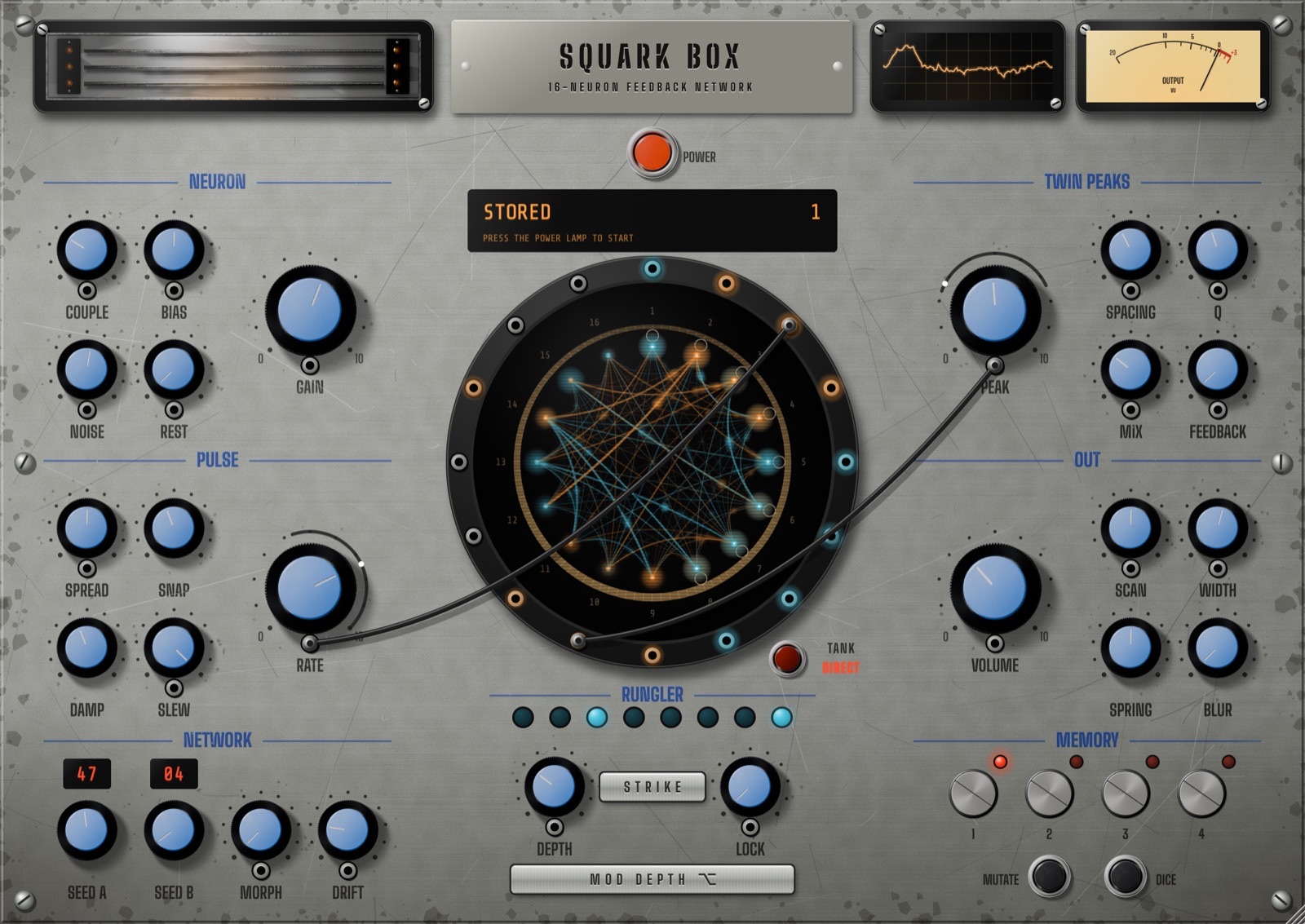
Squark Box is a sixteen-neuron feedback network you can play, built in the spirit of the analog neural-network synthesizers of the late 1980s and early 1990s.
It is a small cybernetic system where every neuron listens to the others and answers back. Think pulses, drones, chirps and slowly shifting rhythms, held somewhere between equilibrium and chaos. You don't tell it what to play; you steer it, and it steers itself.
16 neurons on a live round screen. Tap to rewire them, or turn the seeds for a new network.
Feedback everywhere: neurons pulse, resonate and pull each other into step or out of it.
A shift-register pattern generator, for patterns that repeat or wander.
Twin resonant filter peaks that sing.
Modulation: any neuron can move any knob, so the network can turn its own controls.
Rest, to break chatter into clusters, and STRIKE, to jolt the whole network.
A spring tank and a blur, for space.
Four memory slots. Mutate nudges a few knobs; Dice randomizes the whole box, cables and all.
AUv3 for Live and AUM, as well as a standalone app.
Squark Box loads switched off, so it never makes sound unasked. Press the round red POWER lamp under the name plate to start it. From then on it plays by itself; everything else on the faceplate steers it.
Gain sets how sharply each neuron fires, and so whether its loops break into oscillation at all. Couple sets how strongly the neurons drive each other: near zero they drone on their own, a little higher they find separate pitches, and turned up they lock into simple ratios. Bias pushes every neuron toward on or off. Noise is hiss inside each neuron; low Gain with some Noise is where pitches start to come out of the hiss. Rest makes each neuron ignore the others for a moment after it flips, which breaks chatter into clusters.
Neurons 1 to 8 pulse on their own. Rate sets how fast, and Spread how far apart their speeds are. Snap sets how hard they flip, from soft swells to clicks, and Damp how hard they pull back, which shapes the pulse. Slew sets how fast every neuron can move; turn it down for softer edges.
Seed A and Seed B each choose a wiring for the sixteen neurons. Higher numbers wire more densely, from about one connection into each neuron at 1 to about ten at 99; dense means tangled, not louder. Morph crossfades between wiring A and B, and Drift lets every connection wander slowly over time.
An eight-step shift register, clocked and fed by two of the neurons, whose eight lamps show its pattern. Depth sets how much the pattern moves the pulse speeds, the bias and the resonance. Lock makes the pattern repeat instead of wander. STRIKE, between them, jolts every neuron at once: near the edge of oscillation it sets off a burst, and in a busy patch it scrambles things.
Two resonant filters. Peak sets the frequency of the first, and Spacing places the second as a multiple of it. Q sets how sharp and ringing they are; at the top they ring on their own. Mix sets the resonances against the raw network, and Feedback sends them back into the neurons, so the filters become part of the network.
Volume is the output level. Scan chooses which neurons you are listening to round the ring, and Width how many you hear at once; even neurons go left and odd ones right. Spring sends the sound into a spring reverb tank, and Blur adds a diffuse wash: more, longer and darker. Both are off at zero.
Four plates. Tap one to recall it, and hold one to store the current sound, with its wiring and cables. Mutate nudges a few knobs a little. Dice throws every knob except Volume and Power, and patches new cables.
The round screen shows the sixteen neurons and their wiring, live. The TANK / DIRECT lamp switches which wiring is shown. Tap a neuron, then the one it feeds, to step that connection through off, +½, +1, −1 and −½.
Each pin round the screen carries one neuron's slow movement. Drag from a pin to a knob's jack, or the other way, and that neuron turns the knob. Double-tap a plug to unplug it, or a pin to unplug all of its cables. To set how far a cable moves its knob, use the MOD DEPTH strip, then turn the patched knob. On the Mac, click the strip to latch it, or hold Option. On the iPad, hold the strip, or hold it a moment to latch it; a tap unlatches it.
Squark Box is inspired by the neural-network synthesizer Forrest Warthman, Mark Thorson and Mark Holler built for David Tudor, described in “A Neural-Network Audio Synthesizer” (Dr. Dobb's Journal, February 1993).
The ideas for the rungler and the twin-peak resonator come from Rob Hordijk's Blippoo Box.
Built with JUCE. Fonts: Share Tech Mono, Big Shoulders Stencil and Big Shoulders Text, under the SIL Open Font License.
Free. Available now on Mac. iPad coming soon.